
Choosing the correct saddle width isn't as simple as measuring your sit bones and selecting a number from a chart. Sit bone width is useful. But it's only the starting point. The right saddle needs to: Support your pelvis. Allow your legs to move freely. Match your riding position. Work with your pelvic rotation. Remain comfortable as the ride gets longer. In my experience, the best saddle isn't necessarily the widest, narrowest or most expensive. It's the one that provides enough support that you eventually stop thinking about it. If you're constantly moving around, experiencing numbness or struggling with saddle discomfort, don't immediately assume you need more padding. Start by asking a better question: Is my saddle actually supporting me properly?
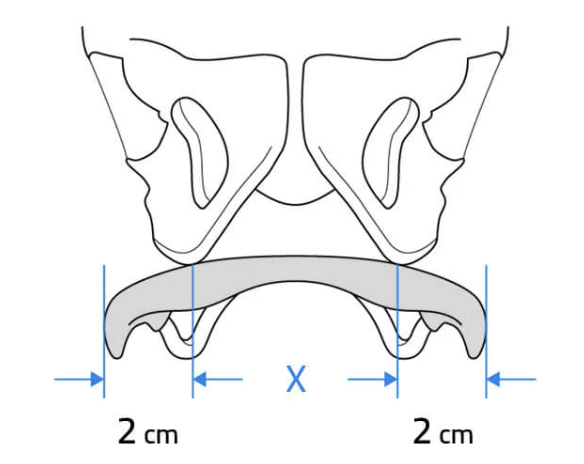
Choosing the right saddle width sounds simple.
Measure your sit bones, add a few millimetres, buy the recommended saddle and start riding.
Unfortunately, it doesn't always work that way.
In my experience, sit bone width is a useful starting point, but it doesn't tell us which saddle will actually support you when you're riding.
I've assessed plenty of cyclists who are technically riding the "correct" saddle width but are still uncomfortable. I've also seen riders become significantly more comfortable after moving to a saddle width they wouldn't necessarily have chosen from a static measurement alone.
The reason is simple:
You don't ride your bike sitting upright on a measuring device.
You lean forward, rotate your pelvis, pedal, change hand positions and move around the saddle.
Choosing the right saddle width means understanding both your anatomy and how you actually ride.
The primary job of your saddle is to provide a stable platform for your pelvis.
When that support is appropriate, your pelvis can remain relatively stable while your legs move underneath you.
When the saddle doesn't provide enough support, your body starts looking for stability elsewhere.
You may:
This is why saddle width isn't simply a comfort measurement.
It influences how your entire body interacts with the bike.
When cyclists talk about saddle width, you'll often hear the term "sit bones."
These are the bony structures at the bottom of your pelvis that help support your body weight when sitting.
Your saddle needs to provide enough support underneath this area of the pelvis.
This is why measuring sit bone width can be useful when choosing a saddle.
But there's an important limitation.
Your sit bone measurement doesn't tell us exactly how you load the saddle while cycling.
And that's where things become more interesting.
Imagine two cyclists with exactly the same sit bone measurement.
The first rider sits relatively upright on an endurance road bike.
The second is a flexible cyclist riding aggressively in the drops.
Their anatomy may be similar.
Their position isn't.
As the second cyclist rotates their pelvis further forwards, the part of the pelvis interacting with the saddle changes.
That means the same saddle may support one rider beautifully and feel completely wrong for the other.
When I'm assessing saddle width, I therefore consider more than the sit bone measurement.
I also look at:
Your anatomy gives us a starting point. Your movement helps determine the final saddle choice.
That's why I don't select saddles from a measurement alone.
A saddle that's too narrow doesn't provide enough support underneath the pelvis.
Instead of your weight being supported effectively, more pressure may be transferred towards sensitive soft tissues.
Common signs can include:
Some riders describe this as feeling like they're sitting "on" the saddle rather than being supported "by" it.
That distinction is important.
A common pattern is a cyclist riding a narrow, performance-focused saddle because it came with the bike or looks appropriate for a fast road bike.
The saddle itself may be excellent.
It simply doesn't provide enough support for that particular rider.
They then try to solve the discomfort with:
Sometimes the simpler solution is giving the pelvis a more appropriate platform.
Potentially, yes.
This is a good example of why I don't assess saddle problems in isolation.
If the pelvis isn't adequately supported, some riders gradually move forwards while riding.
As they move forwards, more body weight transfers towards the handlebars.
That may contribute to:
The rider understandably assumes the problem is at the front of the bike.
But sometimes the chain begins at the saddle.
Poor pelvic support
↓
Rider moves forwards
↓
More weight through the handlebars
↓
Greater pressure through the hands
↓
Upper-body discomfort
This doesn't mean every case of hand numbness is caused by saddle width.
It means saddle support should be considered as part of the assessment.
If narrow saddles can cause problems, why not simply choose a very wide saddle?
Because more support isn't automatically better.
A saddle that's too wide can interfere with how your legs move.
Common signs include:
The goal isn't to support as much of the pelvis as possible.
The goal is to provide enough support without interfering with movement.
This is another common misconception.
A rider experiences saddle discomfort.
They assume:
"I need something wider."
Sometimes that's exactly what they need.
Sometimes it creates an entirely new problem.
I've tested wider saddles with riders where the immediate reaction is:
"That feels much more supportive."
But once they start pedalling, the additional width begins interfering with their movement.
That's why I don't judge a saddle while the rider is sitting still.
The saddle needs to work while you're pedalling.
Your riding position plays a major role in determining how you interact with the saddle.
Generally, the more upright you sit, the more directly you load the rear portion of the pelvis.
As you become more aggressive and rotate forwards, your contact with the saddle changes.
This becomes particularly important when comparing different cycling disciplines.
Road cyclists usually move between several positions during a ride.
You may:
Your saddle needs to provide support across these different positions without restricting movement.
Gravel riders often spend long periods seated while the bike moves underneath them over uneven terrain.
Pelvic support becomes particularly important.
At the same time, the saddle can't be so wide or restrictive that it prevents the rider from moving naturally with the bike.
Triathletes generally rotate the pelvis significantly further forwards when riding in the aero position.
This changes how the front of the pelvis interacts with the saddle.
A traditional saddle-width recommendation based only on static sit bone measurements may therefore be less useful.
For triathletes, saddle width needs to be considered alongside:
This is why triathlon saddle selection often requires a different approach from traditional road saddle selection.
Width should never be considered independently from shape.
Two saddles labelled as the same width can feel completely different.
One may have a relatively flat profile.
Another may curve significantly around the sides.
One may maintain its width further towards the front.
Another may narrow very quickly.
So when a saddle says 145 mm, that doesn't mean every 145 mm saddle will support you in the same way.
The overall shape determines where that width actually supports your pelvis.
Don't shop by width alone.
Width helps narrow your options.
Shape determines whether those options actually work.
Pressure-relief channels and cut-outs are another part of the equation.
A cut-out can be extremely useful for reducing pressure on sensitive tissues.
But a large cut-out doesn't automatically make a saddle comfortable.
The remaining structure still needs to support the pelvis.
If the saddle is too narrow or the shape doesn't suit the rider, adding a larger hole in the middle doesn't necessarily solve the underlying support problem.
My priority is:
Support first. Pressure relief second.
Ideally, you achieve both.
Anatomical differences can influence saddle requirements, but I don't believe saddle selection should simply be reduced to "men's" and "women's" saddles.
The individual rider still matters more.
Two male cyclists can require very different saddle widths.
Likewise, two riders with similar pelvic anatomy may require different saddles because their riding positions are completely different.
Rather than choosing based purely on gender, I prefer assessing:
The saddle should fit the rider—not the category printed on the packaging.
Yes.
Your bones obviously aren't changing every few months.
But the way you interact with the saddle can.
Your saddle requirements may change if you:
This is why a saddle you've happily used for years can sometimes stop working after a major change elsewhere on the bike.
Whenever you change saddle width or saddle model, the rest of the saddle position should be reassessed.
Different saddles have different:
Your new saddle can therefore change your effective saddle height even if the seatpost hasn't moved.
This is one of the reasons riders sometimes develop knee or hip discomfort immediately after installing a new saddle.
They think:
"The new saddle is hurting my knee."
The problem may actually be that the new saddle has subtly changed their effective riding position.
I don't choose saddle width from one measurement.
I build a picture.
Where is the rider uncomfortable?
When does it start?
Does the rider move around?
Are they experiencing pressure, numbness, rubbing or instability?
I consider factors such as:
I look at:
This is the most important part.
I'm looking at whether the pelvis is supported and stable while the legs move freely underneath it.
If I believe the saddle itself is limiting the rider, we'll trial different options.
Sometimes wider works.
Sometimes narrower works.
Sometimes changing the shape produces a bigger improvement than changing the width.
And sometimes we don't change the saddle at all.
The most common mistake isn't choosing a saddle that's dramatically too wide or too narrow.
It's assuming that saddle width can be determined from one number.
Cyclists are often looking for a formula:
Sit bones = X
Therefore saddle = Y.
Bike fitting is rarely that simple.
The measurement matters.
But so does the rider.
And ultimately, the saddle needs to work while you're actually riding the bike.
Sit bone measurement provides a useful starting point, but your riding position, pelvic rotation and saddle shape also need to be considered.
Not necessarily. A wider saddle may provide better pelvic support, but if it's too wide it can interfere with your pedal stroke and cause rubbing or saddle sores.
You may experience poor pelvic support, soft tissue pressure, numbness, instability or excessive movement on the saddle.
You may experience inner-thigh rubbing, restricted movement, saddle sores or difficulty rotating your pelvis comfortably.
It can contribute. If the saddle doesn't support the pelvis appropriately, more pressure may be placed on sensitive soft tissues.
Potentially. A saddle that's excessively wide may interfere with the natural movement of the thighs, while poor pelvic support can create compensations elsewhere in the pedal stroke.
Yes. It's useful information, but don't use the measurement as the only factor when choosing your saddle.
Not automatically. Gravel riders often benefit from good pelvic support, but the correct width still depends on the individual rider and their position.
Not necessarily. Triathlon changes pelvic rotation and where the rider loads the saddle, so width needs to be considered alongside saddle shape and pressure relief.
If the saddle genuinely can't support your pelvis appropriately, replacement may be necessary. But first make sure the saddle position itself has been correctly assessed.
Choosing the correct saddle width isn't as simple as measuring your sit bones and selecting a number from a chart.
Sit bone width is useful.
But it's only the starting point.
The right saddle needs to:
In my experience, the best saddle isn't necessarily the widest, narrowest or most expensive.
It's the one that provides enough support that you eventually stop thinking about it.
If you're constantly moving around, experiencing numbness or struggling with saddle discomfort, don't immediately assume you need more padding.
Start by asking a better question:
Is my saddle actually supporting me properly?
The Complete Guide to Choosing the Right Cycling Saddle
Start here for the complete Forward Bike Fit approach to saddle choice and setup.
The Complete Guide to Cycling Saddle Height
Learn how saddle height influences your knees, hips, pelvis and pedalling efficiency.
Please click book online to make an appointment.
If you have any questions or feedback, feel free to fill out the form, call or send an email to admin@forwardbikefit.au
We would love to hear from you!
📍 29 Stubbs Street, Kensington, Victoria 3031

